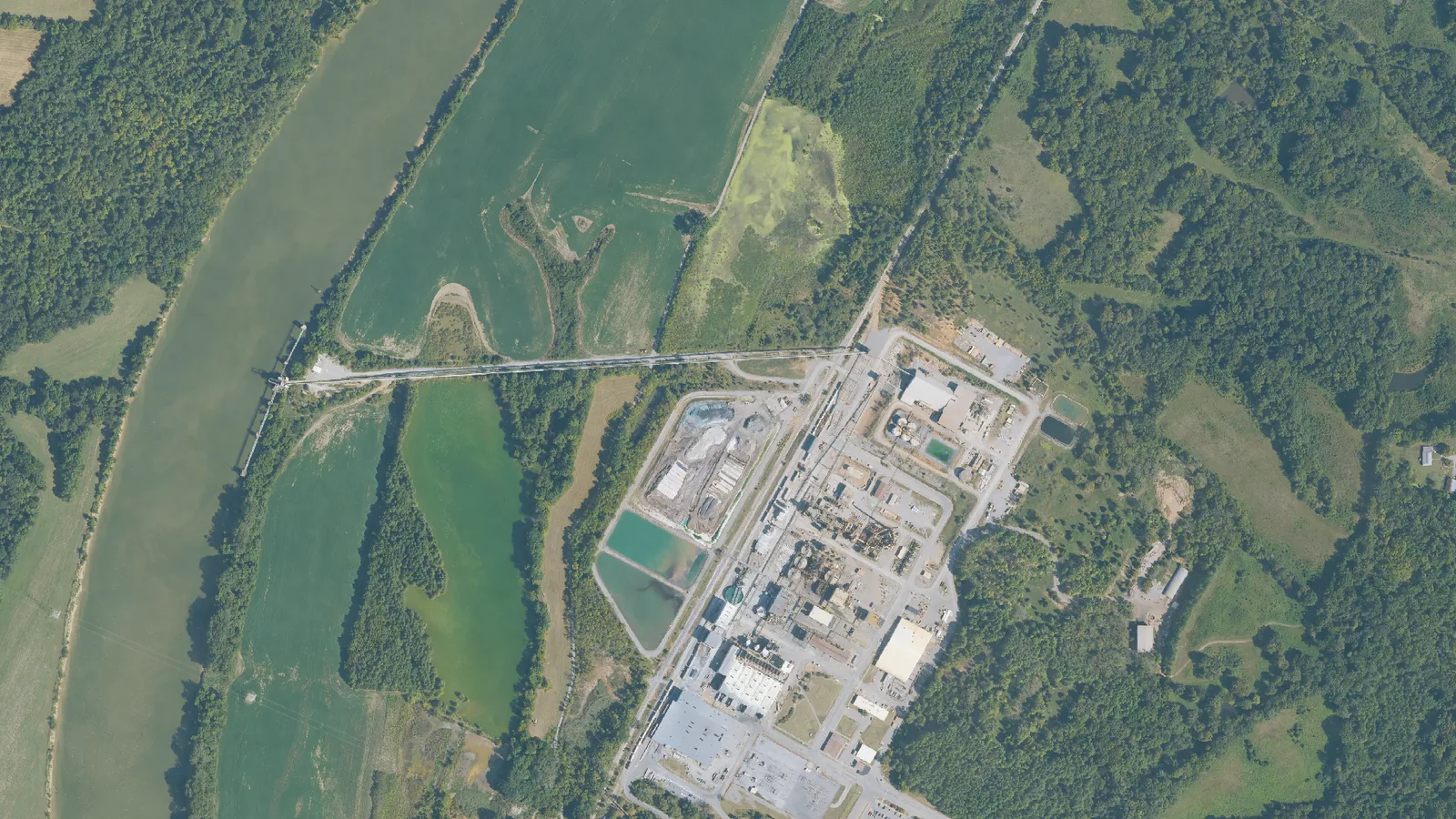
A draft state permit for the Crucible smelter would let it fill 2.08 acres of wetlands and draw 8.8 million gallons a day. Comments are open until Nov. 26.
Overview
The Tennessee Department of Environment and Conservation has drafted a water permit for Project Crucible, the $6.6 billion smelter planned on Zinc Plant Road. It would let the developer fill 2.08 acres of wetlands, pipe a short stretch of stream and build a barge dock on the Cumberland River. It would also raise the site’s river water withdrawal about fivefold. Written comments are due by Nov. 26.
The permit is for Crucible Metals LLC. The new plant would sit beside Crucible Zinc’s existing smelter, according to the federal government’s project listing. The state’s public notice is file No. NRS26.194. TDEC scheduled a public hearing on it for Monday evening at the L&N Train Station. The written comment period stays open after the hearing.
The state has made a preliminary finding that the work would cause only “de minimis degradation” of the water. That is the department’s term for a minor effect. No final decision is made at the hearing.
What the draft permit allows
The draft permit and its rationale cover the work needed to build the plant at 1800 Zinc Plant Road. It would allow:
- filling four wetlands totaling 2.08 acres for a heavy haul road
- running 21.5 feet of an unnamed stream through a metal pipe under that road
- a materials offloading facility on the Cumberland River, with sheet piling and two mooring structures so barges can dock
- new screens and pumps at the existing river water intake
- raising the withdrawal from the river to as much as 6,160 gallons a minute
Three of the four wetlands are rated low quality scrub-shrub. The fourth, 0.28 acres of forested wetland, is rated moderate. The state’s rationale says the stream does not appear on U.S. Geological Survey or soil survey maps.
More water from the Cumberland
The withdrawal is the biggest change in scale. The site now draws about 1,200 gallons a minute, or about 1.7 million gallons a day, according to the draft permit. The permit would cap it at 6,160 gallons a minute, or 8.8 million gallons a day.
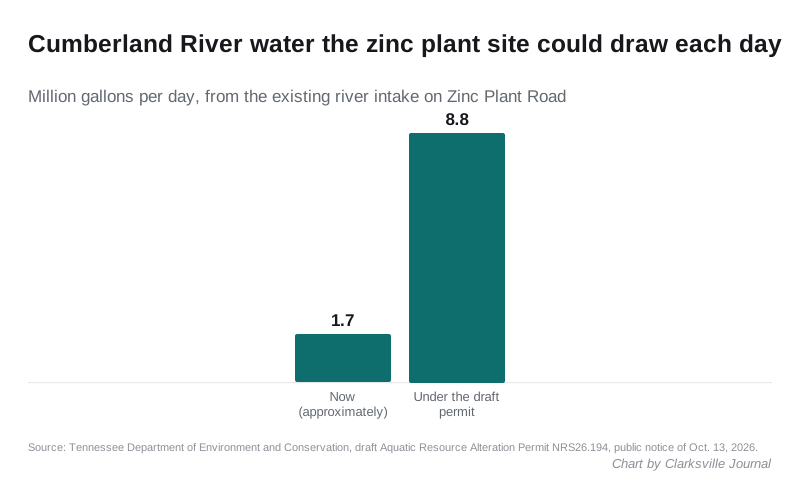
TDEC compared that with the rivers’ lowest weekly flows. It used the Cumberland River below Cheatham Dam and the Red River at Port Royal. The new withdrawal would be 0.4% of their combined low flow, the rationale says. The state’s rules count a single withdrawal under 5% of that low flow as minor. The permit requires the developer to record its river withdrawal daily and report it to the state.
Why a barge dock
The developer’s case for the dock is in the alternatives section of the rationale. Some process equipment arrives in modules that weigh about 500 tons. River Road has a weight limit of 10 tons, the rationale says. Tennessee’s legal gross weight for trucks is 40 tons, and standard freight rail cars carry 100 to 115 tons. Construction also needs 48,000 tons of steel. One barge carries as much as 35 rail cars or 134 trucks, the document says.
The developer weighed four options. A route with no dock would have touched no streams or wetlands, but the rationale says it would slow delivery and stretch the construction schedule. The chosen route affects more wetland than the original design. It avoids two archaeological sites in the river floodplain that the original route would have damaged.
Historic sites and mitigation
Surveys found three sites on the plant property that are eligible for historic listing. The rationale says harm to all three cannot be avoided under any option.
To make up for the lost wetlands, the developer must buy 3.96 acres of wetland mitigation credits, a 2-to-1 ratio. Most come from the Bumpus Mills Mitigation Bank in Stewart County, where it has reserved 3.87 credits. The rest come from the Tennessee Mitigation Fund. No stream mitigation is required under state law for 21.5 feet of stream, the rationale says.
Where the project stands
Project Crucible is listed on the federal Permitting Dashboard as a fast-tracked project, with the Department of War as lead agency. The listing says the plant would produce 12 metals, including zinc, lead, copper, gold, antimony, gallium and germanium, plus semiconductor-grade sulfuric acid. Eleven of those metals are on the federal critical minerals list. The dashboard shows four of 10 federal reviews complete. It estimates the environmental review and permitting will finish by Sept. 30, 2028.
The U.S. Army Corps of Engineers and the U.S. Fish and Wildlife Service also have reviews on the project. The state permit covers water quality only.
What it means for you
- Comment in writing by Nov. 26. That date is Thanksgiving Day, though the notice calls it a Saturday. Email is simplest: ARAP.permits@tn.gov. Name Crucible Metals and permit NRS26.194.
- Mail works too. Send it to permit coordinator Theron Binford, TDEC Division of Water Resources, Davy Crockett Tower, 500 James Robertson Parkway, 9th Floor, Nashville, TN 37243.
- Commenting keeps your right to appeal. Under the notice, only the applicant or someone who commented in writing or spoke at the hearing can appeal the final permit.
- Read the full file. The application, plans and maps are on TDEC’s Water Resources Permits Dataviewer under NRS26.194.
- Need help in another language? TDEC offers free translation through Brian Canada, 615-979-1406.
TDEC will answer every comment in writing when it makes its final decision.
Have your say