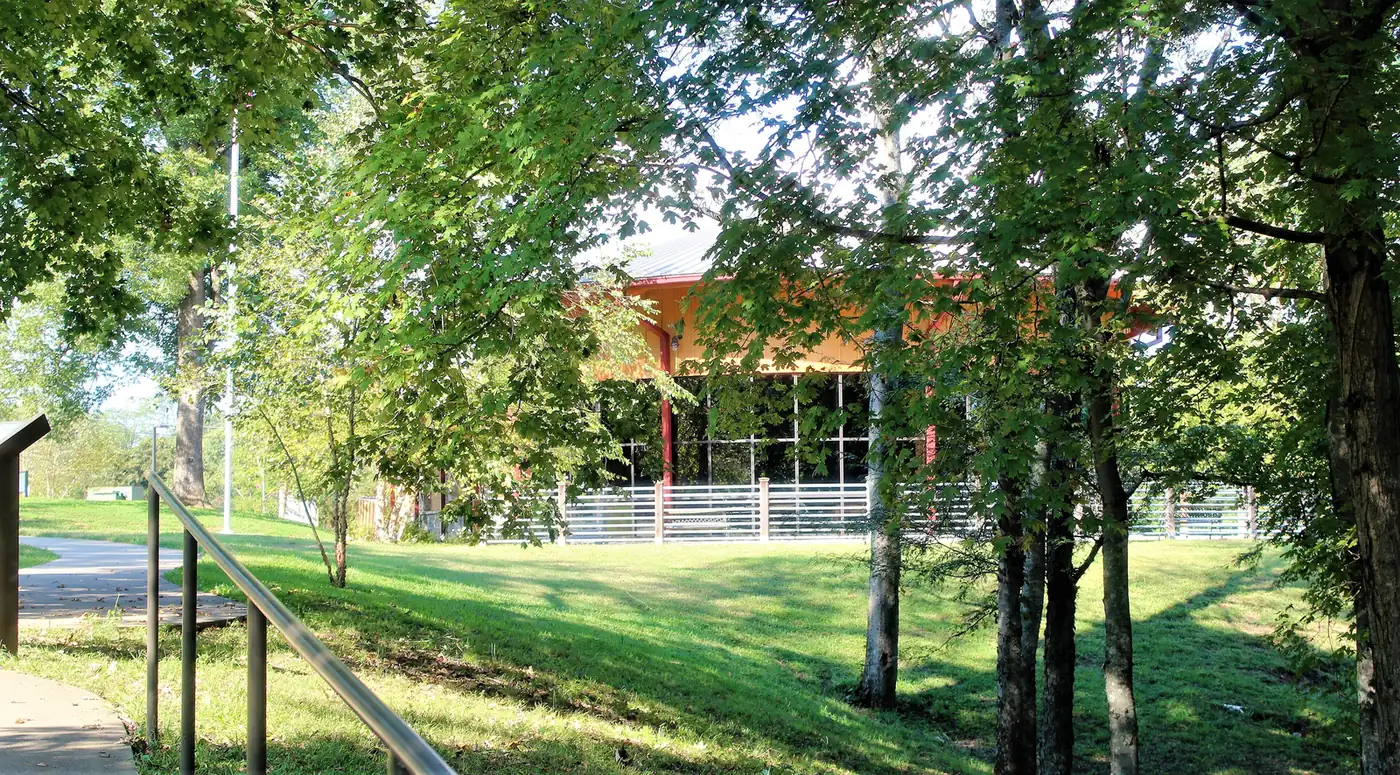
Clarksville was established in 1784 and named for George Rogers Clark. Its National Register sites, Fort Defiance, the Customs House Museum and Riverview Cemetery.
Last checked Oct. 17, 2026. History comes from the Tennessee Historical Society’s Tennessee Encyclopedia entry on Clarksville; listings from the National Park Service’s National Register of Historic Places database (May 22, 2026, file); visitor details from the City of Clarksville’s historical properties and Riverview Cemetery pages and the Customs House Museum.
Clarksville was established in 1784 by the North Carolina legislature as the seat of Tennessee County, twelve years before Tennessee became a state, and named for Revolutionary War hero George Rogers Clark, the Tennessee Encyclopedia says. It is the second-oldest town in Middle Tennessee. Start a visit at Fort Defiance, 931-472-3351, or the Customs House Museum downtown.
Who to call
- Fort Defiance Civil War Park & Interpretive Center: 931-472-3351, 120 Duncan St.
- Riverview Cemetery office: 931-553-2441, 635 N. Spring St.
- Dunbar Cave State Park: 931-648-5526, 401 Old Dunbar Cave Road
- Historic preservation and design review: Regional Planning Commission, 931-645-7448
A short history
- 1784: Established on land North Carolina set aside to pay its Revolutionary War soldiers.
- 1788: Named a tobacco inspection point; dark-fired tobacco from the Highland Rim soils made the river town a trade center.
- 1796: Tennessee statehood. The Clarksville Chronicle starts in 1808; resident Willie Blount is elected governor in 1809.
- 1820: The first steamboat reaches Clarksville. By 1858 more than 18,000 hogsheads of dark-fired tobacco ship to markets abroad.
- 1859-60: The Memphis, Clarksville and Louisville Railroad opens a bridge over the Cumberland.
- February 1862: Confederate troops abandon Fort Defiance and Fort Clark as a Union flotilla approaches; Union occupation lasts until September 1865.
- 1878: A fire destroys 15 acres of the central business district.
- 1919: The Women’s Bank of Tennessee opens, the first bank in the nation run entirely by women.
- 1941: The War Department opens Camp Campbell north of town; it becomes Fort Campbell in 1950.
- 1956: Austin Peay State College admits its first Black student, Wilbur Daniel.
- 1960: Clarksville’s Wilma Rudolph wins multiple gold medals at the Summer Olympics.
- 1975-76: I-24 is completed through the area.
Historic districts and the National Register
The National Park Service lists these places with Clarksville street addresses on the National Register of Historic Places, with the date each was listed:
| Listing | Address | Listed |
|---|---|---|
| Emerald Hill | N. Second St. | 1971 |
| Sevier Station | 326 Walker St. | 1971 |
| Clarksville Federal Building (Customs House Museum) | 200 S. Second St. | 1972 |
| Poston Block | 126-130 Public Square | 1972 |
| Clarksville Industrial District | Washington St. to the Cumberland River | 1976 |
| Clarksville Architectural District | Public Square, Legion, Third, Franklin and Commerce streets | 1976 |
| First Presbyterian Church | 213 Main St. | 1976 |
| Madison Street Methodist Church | 319 Madison St. | 1976 |
| Samuel Rexinger House | 813 College St. | 1977 |
| Smith-Hoffman House | 149 Plum St. | 1977 |
| Dog Hill Architectural District | Munford Avenue, First, Union, Madison and Second streets | 1980 |
| Oak Top | 107 Madison Terrace | 1980 |
| Fort Defiance CSA/Fort Bruce USA | Park at 120 Duncan St. | 1982 |
| Catholic Church and Rectory | 716 Franklin St. | 1982 |
| Clarksville Methodist Church | 334 Main St. | 1982 |
| St. Peter African Methodist Church | 518 Franklin St. | 1982 |
| Trinity Church and Rectory | 317 Franklin St. | 1982 |
| Clarksville High School | Greenwood Avenue | 1983 |
| Clarksville Foundry and Machine Works Office | 96 Commerce St. | 1987 |
| Christopher H. Smith House | Spring and McClure streets | 1988 |
| Forbes-Mabry House | 607 N. Second St. | 1995 |
| Glenwood Historic District | Glenwood Drive | 1996 |
| Johnson-Hach House | 403 Greenwood Ave. | 1998 |
| Tip Top | 15 Trahern Terrace | 1998 |
| Dunlop Milling Company | 1138 Franklin St. | 1999 |
| Madison Street Historic District | Madison Street | 1999 |
| Alfred A. Robb House | 529 York St. | 2000 |
| Northington-Beach House | 512 Madison St. | 2001 |
| First Presbyterian Church Manse | 305 Main St. | 2001 |
| Country Woman’s Club | 2216 Old Russellville Pike | 2006 |
| Mt. Olive Cemetery | 951 Cumberland Drive | 2020 |
| Dunlop House | 517 Madison St. | 2025 |
Montgomery County has more listings outside the city, including Cloverlands, Riverview, Whitehall, the Old Post House on U.S. 41A and a string of 19th-century iron furnace sites.
Places to visit
Fort Defiance Civil War Park & Interpretive Center, 120 Duncan St. The fort sits on a bluff 200 feet above where the Red River meets the Cumberland. Union forces took it in February 1862; it later drew freedom seekers and became an enlistment site for the U.S. Colored Troops. The earthworks, powder magazine and gun platforms are still visible, with nearly a mile of trails and a 1,500-square-foot interpretive center. Fall and winter hours: 10 a.m. to 4 p.m. Tuesday through Saturday, 1 to 4 p.m. Sunday; spring and summer close at 5 p.m. Closed Monday. Free.
Customs House Museum & Cultural Center, Second and Commerce streets. Built in 1898 as a federal post office and customs house for the tobacco trade, listed on the National Register in 1972 and opened as a museum in 1984. Open 10 a.m. to 5 p.m. Tuesday through Saturday and 1 to 5 p.m. Sunday; closed Monday and major holidays. Admission is charged; it offers a free self-guided walking tour brochure of downtown landmarks.
Riverview Cemetery, 635 N. Spring St. The city cemetery since Feb. 23, 1800, on land given by Valentine Sevier, its first recorded burial. Two Revolutionary War veterans are buried here, along with a mass grave of more than 125 Confederate soldiers. Open 8 a.m. to sunset; office 7 a.m. to 3:30 p.m. weekdays.
Dunbar Cave State Park, 401 Old Dunbar Cave Road. A cave with prehistoric Native American cave art; guided tours May through September. See our parks guide.
What this means for you
- Fort Defiance is free and open six days a week; its fall hours end at 4 p.m.
- For a self-guided start, pick up the Customs House Museum’s downtown walking tour.
- Changing a building in a historic district? Talk to the Regional Planning Commission first.
More guides: things to do this month, population and growth and getting around Clarksville.
Frequently asked questions
When was Clarksville, Tennessee, founded?
In 1784, when the North Carolina legislature established it as the seat of Tennessee County, before Tennessee was a state, according to the Tennessee Encyclopedia.
Who is Clarksville named after?
George Rogers Clark, the Revolutionary War hero.
What are the hours at Fort Defiance in Clarksville?
Fall and winter: 10 a.m. to 4 p.m. Tuesday through Saturday and 1 to 4 p.m. Sunday; closed Monday. Admission is free. Phone 931-472-3351.
What is the Customs House Museum?
A history, art and culture museum in an 1898 federal post office and customs house at Second and Commerce streets. It is open 10 a.m. to 5 p.m. Tuesday through Saturday and 1 to 5 p.m. Sunday.
Have your say